
Wine storage · estate columns
Sub-Zero wine storage repair for Eagle Ridge & Glen Loma estates
When an estate wine column drifts warm or one zone stops holding, the cellar is at risk. We recalibrate dual-zone Sub-Zero wine storage and fix the sensors, seals, fans and controls behind it — locally, with genuine OEM parts.
$89 service call, waived when you book the repair · 365-day warranty on all labor.
Quick answer
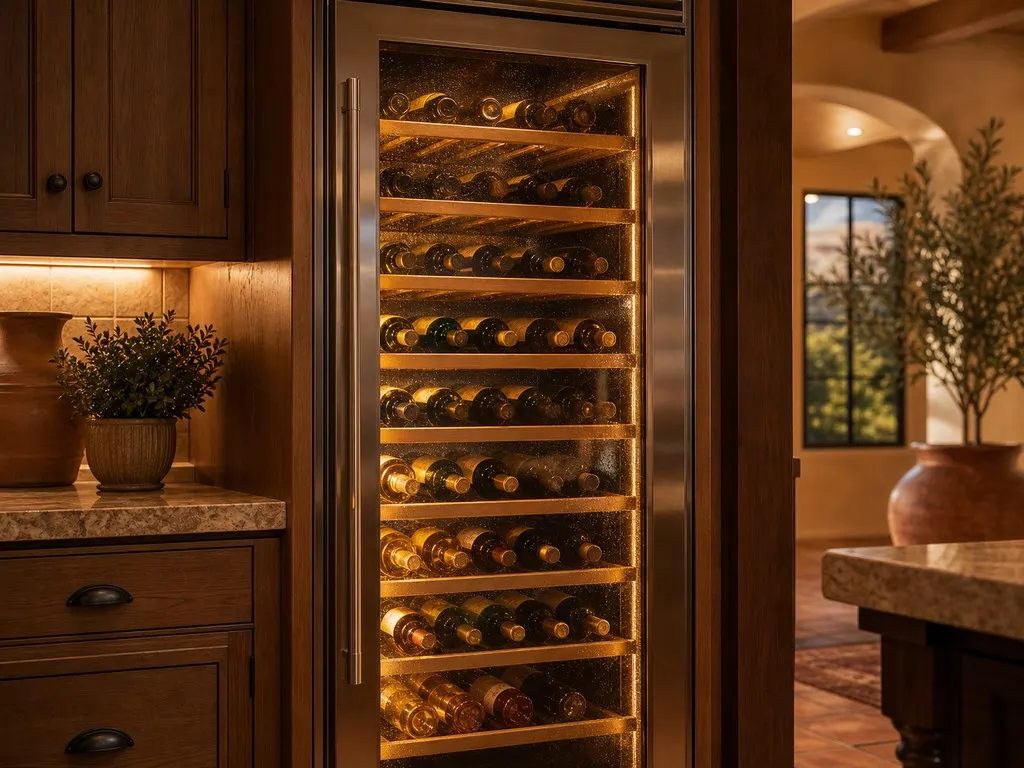
A Sub-Zero wine column that runs warm or loses a zone is usually a failed control sensor, a tired evaporator fan, a worn door seal, a clogged condenser, or a control board that has dropped one zone out of calibration — rarely the sealed system. We diagnose the exact cause, recalibrate both zones so reds and whites hold, and fit genuine OEM parts. The $89 service call is waived when you book the repair, and all labor carries a 365-day warranty.
Wine storage symptom, cause and next step
What your Sub-Zero wine column is telling you — and what we do about it.
| Symptom | Likely cause | What we do |
|---|---|---|
| Whole cabinet drifting warm | Dust-clogged condenser, a failing evaporator fan, or a refrigerant loss in the sealed system | Clean and test the condenser and fan; verify sealed-system performance before recommending anything. |
| One zone warm, the other fine | A failed zone sensor, a stuck air damper, or a control board that has lost that zone’s calibration | Test each sensor and the damper, then recalibrate the affected zone so reds and whites separate again. |
| Zones will not hold their set points | Drifted calibration, a weak fan, or a sensor reading out of range | Confirm true cabinet temperatures with instruments and recalibrate to spec; replace the weak component. |
| Condensation or frost inside the door | A worn or pinched gasket letting warm, humid air into the cabinet | Inspect and replace the door seal; confirm humidity settles back into range. |
| Excess vibration or louder running | Loose racking, a worn fan motor, or feet out of level on a long install | Re-level, secure the racking, and replace the fan if bearings are worn so bottles rest still. |
| Flashing light or service indicator | Sensor fault, a door left ajar, or a logged control warning | Read the indicator, confirm whether it is a real fault, and clear or repair the underlying cause. |
Causes are typical for South County wine columns; your unit may differ. We confirm every diagnosis with proper testing before any genuine OEM part is fitted.
Ideal Sub-Zero wine storage targets by zone
What each zone of a dual-zone estate column should be holding once we recalibrate it — a reference for how reds, whites and sparkling are best stored.
| Zone / wine type | General target band | Note |
|---|---|---|
| Upper zone — reds | Cellar warm, roughly the mid-50s to low-60s °F | A steadier serving-and-aging band; this is the zone owners most often find drifted toward room temperature. |
| Lower zone — whites | Cooler, roughly the upper-40s to low-50s °F | Whites and rosés prefer the cooler half; we calibrate this zone independently of the reds. |
| Sparkling / Champagne | Coolest setting the lower zone allows | Best stored on the cool end and served colder still; a stable setting protects the cork over time. |
| Long-term aging (any wine) | Hold the band steady, not just low | Stability matters more than the exact number — a column that swings ages wine faster than one a few degrees off but steady. |
| Single-zone cabinet | One compromise cellar band, around the mid-50s °F | If you store mostly one style, we set a single band suited to it rather than splitting the cabinet. |
Targets are general storage guidance, not a Sub-Zero specification; we set each zone to how you actually store your collection and confirm true cabinet temperatures with instruments.
Why estate wine columns drift — and why dual-zone matters
Out in Eagle Ridge and Glen Loma, the wine column is rarely a small countertop unit. It is a built-in or integrated Sub-Zero column, often a dual-zone cabinet set up to hold reds in the upper zone and whites or sparkling in the lower — two different temperatures from one cabinet. That dual-zone control is exactly what tends to drift over the years, and a cellar full of bottles is unforgiving when it does.
Each zone relies on its own sensor, an air damper, an evaporator fan and the control board reading them together. When one sensor ages or the board loses its calibration, you get the classic complaint: one zone warm, the other fine, or both zones holding a few degrees off where the display claims they are. Reds creep toward room temperature, whites lose their edge, and the bottles you have been laying down for years are slowly cooked.
Our hot, dusty South County summers make it worse. A wine column shares the same enemies as a built-in fridge — a condenser that packs with dust behind a long rural driveway and a fan working overtime in a west-facing kitchen — so a marginal cabinet tips into “running warm” during the first real heat wave. We see this every June. The fix is almost never a full replacement; it is a sensor, a fan, a seal, a condenser clean, and a proper recalibration of both zones.
The repairs we make most on wine storage
Wine storage failures cluster into a handful of fixable causes. Knowing the platform means we arrive prepared and diagnose faster:
- Dual-zone calibration — re-reading both zones with instruments and bringing the control board back to spec so reds and whites hold independently. This is the single most common wine call we take. See wine fridge running warm for the warm-zone symptom in detail.
- Zone sensors & thermistors — a failed sensor reads out of range and the board chases the wrong target; a genuine OEM sensor and a calibration check usually settles it.
- Evaporator fans — a worn fan starves a zone of cold air or adds vibration that disturbs sediment in the bottles. Covered further under wine cooler repair.
- Door seals & UV glass — a worn gasket lets warm, humid air in and upsets humidity; the tinted, UV-treated glass door protects the bottles and the lighting from heat load, and we handle both carefully.
- Condenser & humidity control — a clogged condenser or blocked drain throws off both temperature and the cabinet’s humidity. More patterns are collected under wine storage issues.
Most of these are wear items, far cheaper to repair than to replace a column. We give honest repair-vs-replace advice on the spot rather than pushing a sale.
Quick answers
Wine storage repair — quick answers
Can you fix dual-zone calibration?
Yes. We measure true cabinet temperatures, test each zone’s sensor and damper, and recalibrate the control so reds and whites hold separately.
How much to diagnose?
The diagnosis is a flat $89 service call, waived when you book the repair; most wine-column fixes then land in the hundreds, with a sealed-system job higher.
Why is it worse in summer?
South County heat and dust load the condenser, so a marginal column drifts warm during the first heat wave. A clean and fan check usually restores it.
Is the repair guaranteed?
Yes — dual-zone recalibration and every part we fit carry a 365-day labor warranty, all on genuine OEM components.
Reviews
Wine storage repairs across South County
Our wine column drifted up to cellar-ruining temperatures. They replaced a failed control sensor and recalibrated both zones so the reds and whites hold properly again. Treated the cabinetry and bottles with real care.
Wine fridge was getting warm and the light kept flashing. Diagnosis was quick and the repair held. Took one extra day to get the exact OEM part, which they were upfront about — worth the wait for the right component.
Our built-in Sub-Zero stopped holding temperature the week of a family party. They came out to Eagle Ridge, diagnosed a failing evaporator fan, and had it cold again the same visit. The $89 service call was waived once we approved the repair — straightforward and honest.
Our built-in is 18 years old and I assumed it was done. They serviced the sealed system and a few worn parts instead, and it’s running like new. Saved us from a five-figure replacement. Genuinely honest advice about repair vs replace.
FAQ
Sub-Zero wine storage — FAQ
Why is my Sub-Zero wine column running warm?
Can you repair dual-zone calibration so reds and whites hold separately?
Is it worth repairing an older 423, 424 or 427 wine column?
One zone is warm but the other is fine — what causes that?
My wine column vibrates and the bottles rattle — is that normal?
Will repair affect the humidity or the UV glass door?
Do you come out to Eagle Ridge and Glen Loma estates?
How fast can you get to a warm wine column?
Related wine storage help
Protect the cellar — book a wine storage diagnosis
Get a local specialist out to your Eagle Ridge or Glen Loma column and recalibrate both zones before the bottles pay for it. The $89 service call is credited back once you book the repair.
$89 service call, waived when you book the repair · 365-day warranty on all labor.