
Sealed system · summer load
Sub-Zero sealed system & compressor — why Gilroy summers push them hardest
Hot Hecker Pass afternoons and fine inland dust make a built-in work overtime. Here is how the condenser, compressor and sealed system actually fail in a South County summer — and how a local specialist proves the cause before quoting a major repair.
$89 service call, waived when you book the repair · 365-day warranty on all labor.
Quick answer
In a Gilroy summer, a Sub-Zero usually struggles because heat and dust overload the condenser and force the compressor to run nearly nonstop — not because the sealed system has failed. Clean the condenser, give the unit airflow and shade, and confirm the doors seal. If it still cannot hold temperature, book a diagnosis: we verify any sealed-system or compressor repair with pressure and electrical readings first. The diagnosis is a flat $89 service call that comes off the bill once you book the repair.
Which “cooling system” this is — and which it is not
People in Gilroy search for a “cooling system repair” and mean three different machines. To be clear about what we do: we repair the built-in refrigeration cooling system inside your Sub-Zero — the condenser, compressor, evaporator, fans and sealed refrigerant circuit that keep food and wine cold.
We do not service home air-conditioning or HVAC, and we do not work on RV or recreational-vehicle refrigerators. If your house AC is out or your motorhome fridge quit on a trip, we are the wrong call. But if your Sub-Zero built-in is running warm, running constantly, or short-cycling in the summer heat, the sealed system is exactly our specialty.
How the sealed system works
Condenser, compressor and the sealed circuit
A built-in moves heat out of the cabinet and dumps it into your kitchen using a sealed loop of refrigerant. Three parts carry the load:
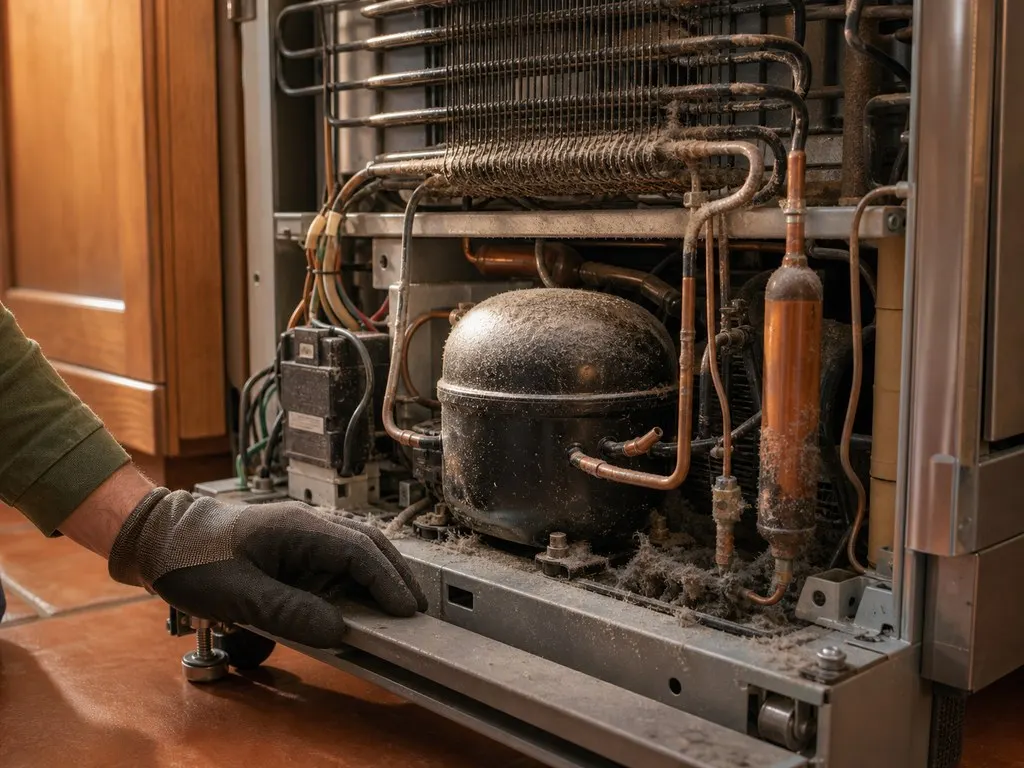
The condenser is the coil behind the lower grille that sheds heat. The compressor pumps the refrigerant around the loop. The sealed system is the closed circuit — compressor, condenser, evaporator, drier and capillary — that the refrigerant runs through. When the condenser cannot shed heat, head pressure climbs, the compressor runs hotter and longer, and the whole loop loses efficiency.
That is why a marginal unit sails through winter and falls over in July: the same wear that was invisible at 65°F becomes a warm fridge at 100°F.
- Condenser: sheds cabinet heat — first to suffer from dust and heat
- Compressor: pumps refrigerant; runs hot and long when starved of airflow
- Sealed system: closed loop tested by pressure, never by guesswork
Why South County summers are hard on a Sub-Zero
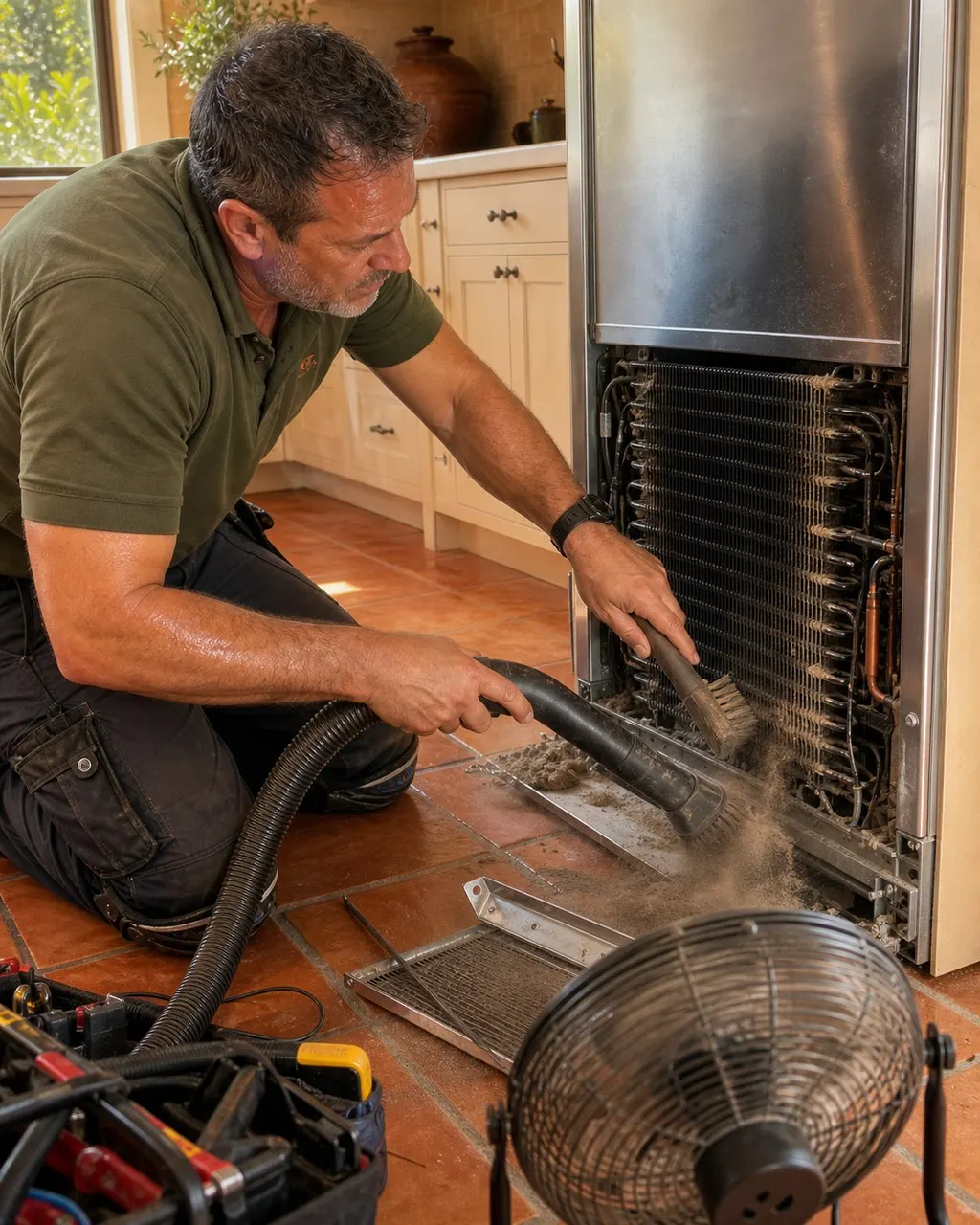
Gilroy and Hecker Pass summers are hot and dry, and the inland air carries a lot of fine dust — orchard, field and long unpaved driveway dust out toward San Martin and the western foothills. That dust does one specific thing to a built-in: it mats the condenser coil and the grille, so the unit can no longer shed heat efficiently.
The effect is worst in the big Eagle Ridge and Glen Loma estate kitchens. A large west-facing kitchen takes direct afternoon sun, the room itself runs warm, and a tall column or a pair of built-ins has to reject more heat than it ever does in a cooler month. Add a clogged condenser to that load and a healthy fridge tips into “not cooling” during the first real heat wave of the season.
The encouraging part: the overwhelming majority of summer calls are a dirty condenser, a tired condenser fan, or a worn gasket — wear items that cost a fraction of a sealed-system repair. We find those first, before anyone talks about a compressor.
Summer heat symptom → cause → action
What the unit is telling you when the temperature climbs in a hot week.
| Symptom | Likely cause | What to do |
|---|---|---|
| Warm during heat waves, fine when cool | Dust-clogged condenser or weak condenser fan losing capacity under load | Clean the condenser and confirm the fan runs; this restores most units without further work. |
| Compressor runs almost constantly | Heat-stressed condenser, lost airflow clearance, or an aging compressor working harder | Clear airflow and clean the coil; if it never recovers, book a diagnosis with pressure readings. |
| Short-cycling (starts, then stops quickly) | Overheating compressor tripping on thermal overload, or a failing start relay | Let the condenser cool and stay clean; book an electrical diagnosis if it keeps cycling. |
| Both compartments slowly warming | Restricted condenser plus high room heat, or a genuine sealed-system loss | Rule out airflow first; a true sealed-system fault is confirmed only by pressure testing. |
| Hot kitchen, unit loud and hot to touch | Condenser rejecting heat into a hot west-facing room with poor clearance | Improve airflow and shade; if noise and heat persist, have the compressor and fan checked. |
Causes are typical for South County built-ins; your unit may differ. We confirm with proper pressure and electrical testing before any sealed-system part is replaced.
How it works
Reduce the summer load on your built-in
Do these before the next heat wave. If the unit still cannot hold temperature, it is time for a diagnosis.
- 1
Clean the condenser
Vacuum and brush the coil and grille every few months in summer — dusty inland air packs it fast and traps heat.
- 2
Clear the airflow path
Keep the grille unblocked and leave clearance above and beside the unit so it sheds heat instead of recirculating it.
- 3
Shade a west-facing kitchen
Close blinds on hot afternoons; direct sun raises the cabinet load during a heat wave.
- 4
Check the door seals
Make sure gaskets seal cleanly so the compressor is not fighting warm humid air leaking in.
- 5
Watch the recovery
Give it hours to recover after a big restock; constant running with no recovery is the sign to book a diagnosis.
We do not guess at a sealed-system repair
A compressor or sealed-system repair is the most expensive thing a built-in can need, so we hold it to the highest bar. We never propose one on a hunch or a hot-to-the-touch coil.
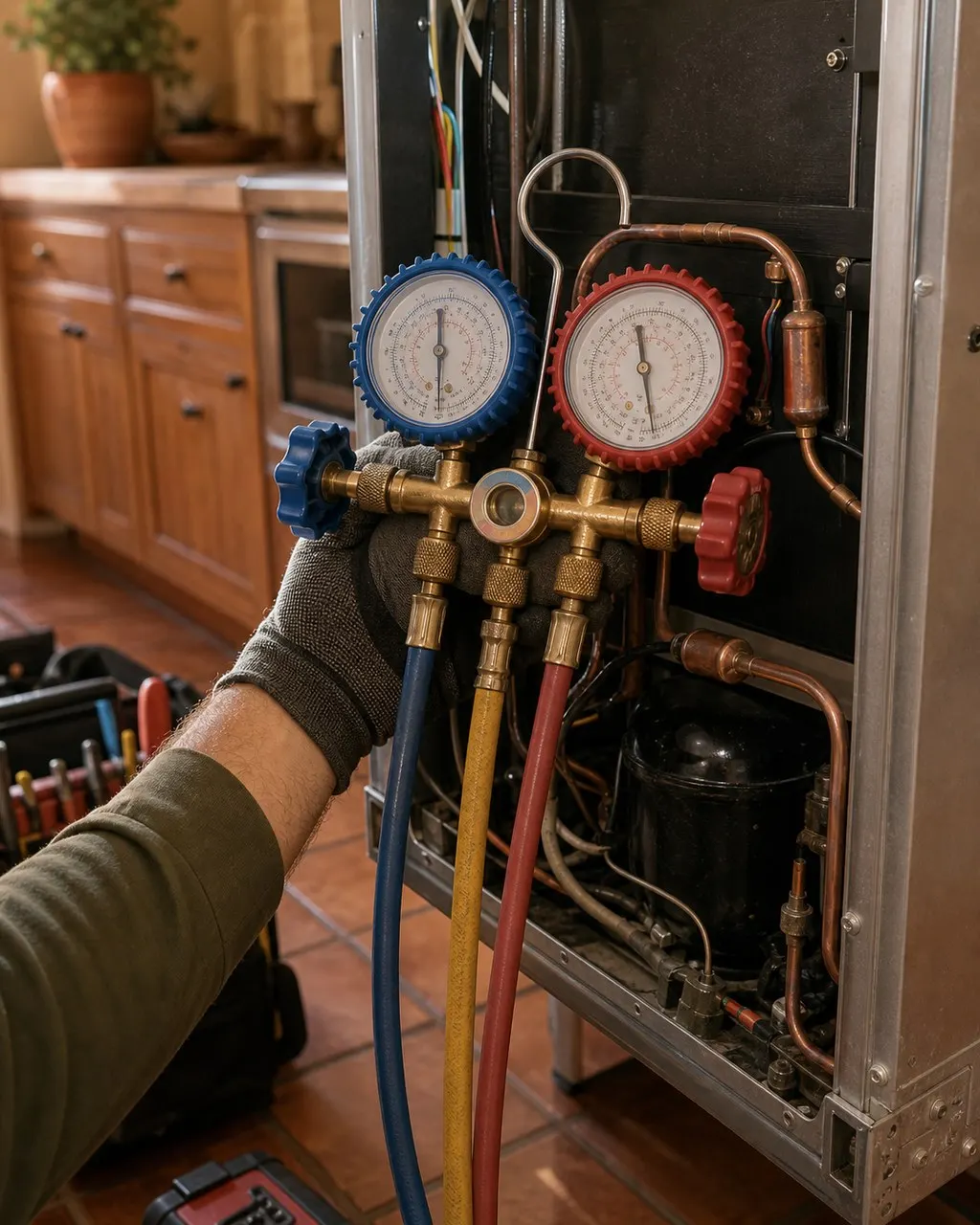
A sealed-system diagnosis means attaching gauges and reading actual head and suction pressures, measuring compressor electrical draw and the start circuit, and confirming the fault is in the sealed loop and not a dirty condenser, a stuck fan or a control problem. Only when the pressure and electrical evidence agree do we recommend a sealed-system repair — and we explain repair-vs-replace honestly, because on a well-kept Sub-Zero the cabinet and sealed system often outlast everything else. Every repair uses genuine OEM parts and carries a 365-day labor warranty.
What our sealed-system readings tell us
The checks we run before ever naming a compressor or sealed-system repair, and what each one rules in or out.
| Reading we take | What it tells us | What it rules out |
|---|---|---|
| Condenser & coil condition | Whether dust and heat are the real limit on a hot day | A clean coil rules out the most common summer cause |
| Condenser fan operation | Whether airflow across the coil is actually happening | A running fan rules out a stalled-fan heat build-up |
| Head & suction pressures | Whether the refrigerant charge and flow are normal | Healthy pressures rule out a sealed-system loss |
| Compressor electrical draw | Whether the motor is pulling normal current under load | Normal draw rules out a failing compressor |
| Start circuit / relay | Whether the compressor is starting cleanly | A good start circuit rules out relay-driven short-cycling |
We recommend a sealed-system repair only when the pressure and electrical readings agree — never on a hunch. The $89 service call is waived when you book the repair.
Quick answers
Summer heat & sealed system — quick answers
Is it really the compressor?
Usually not. Most summer calls are a dirty condenser, a weak fan or a worn gasket — far cheaper than a compressor or sealed-system repair.
How do you confirm a sealed-system fault?
With gauges and meters — actual pressure and electrical readings. We never quote a sealed-system repair on a guess.
Why only in summer?
Gilroy heat and inland dust overload the condenser, so a marginal unit that coped all winter tips into “not cooling” during a heat wave.
What does diagnosis cost?
The diagnosis is a flat $89 service call, waived when you book the repair; common repairs land in the hundreds, while a sealed-system or compressor job runs higher.
Reviews
Summer & sealed-system repairs in South County
Big estate kitchen, west-facing, and the built-in just couldn’t keep up during the heat wave. They cleaned a badly clogged condenser and checked the sealed-system pressures properly. Runs quiet and cold now. Honest about what was and wasn’t worth doing.
Fridge side was warm but the freezer was fine. They traced it to a frosted-over evaporator and a tired defrost sensor, cleaned the heat-stressed condenser too. Cold and steady again even in this June heat. Fair $89 call fee, waived with the fix.
Finally a Sub-Zero specialist who actually works in South County instead of treating Gilroy as an afterthought. Clear quote, genuine parts, and the 365-day labor warranty gave me real peace of mind on a pricey repair.
Built-in wasn’t cooling at all. They worked through it methodically — power, fans, sealed system — and found a failed compressor relay rather than assuming the worst. Back to cold the same day.
FAQ
Sub-Zero summer heat & sealed system — FAQ
My Sub-Zero only struggles when it gets hot outside — is that normal?
How do I know if it is the condenser or the compressor?
Will cleaning the condenser actually fix it?
Do you repair sealed systems and compressors, or just replace the unit?
Do you fix home air conditioning or RV refrigerators too?
How fast can you reach Eagle Ridge or Hecker Pass in a heat wave?
Can I prevent summer failures?
Related Sub-Zero help

Running warm in the heat? Let’s find out why.
Book a sealed-system diagnosis with a local South County specialist — we confirm the cause with real readings, and the $89 service call is waived when you book the repair.
$89 service call, waived when you book the repair · 365-day warranty on all labor.