
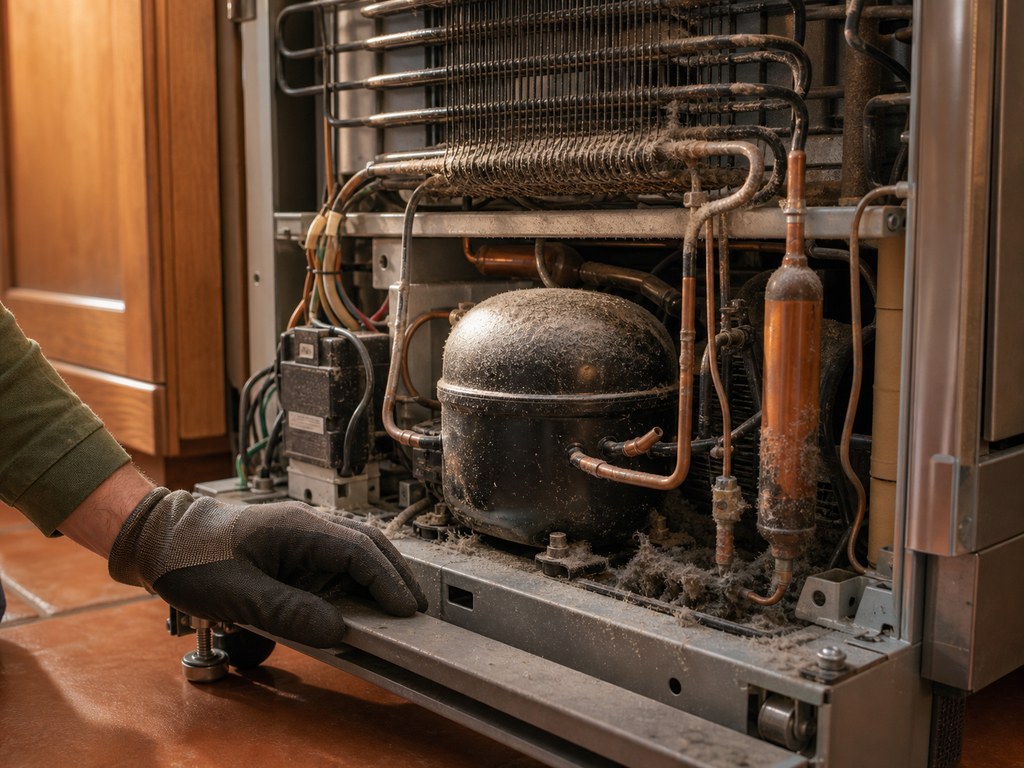
Sub-Zero's wine storage line — the tall integrated columns and under-counter wine units — is a different animal from the company's refrigerators, even though they share a parts catalog and a service philosophy. A wine unit is asked to hold a tighter band, hold it longer, and do it while sitting still enough not to disturb sediment. That is a lot to ask of a small sealed system, and in a Gilroy kitchen it gets asked on the hottest days of the year.
Most owners call us the moment a number on the display looks wrong. Before that call, it helps to know what the symptom is actually telling you — because the difference between a forty-minute gasket job and a sealed-system repair usually shows itself early, if you know how to read it.
How dual-zone control is supposed to behave
A dual-zone Sub-Zero wine unit runs two independently managed compartments off one refrigeration circuit — a cooler white zone and a warmer red zone, each with its own sensor and its own damper or evaporator path. The electronics modulate airflow between them to hold each within a degree or two of its set point. When that choreography is healthy, you can run reds at cellar temperature up top and whites at serving temperature below without either one wandering.
The first sign of trouble is usually one zone — almost always the colder one — losing its grip while the other looks fine. That asymmetry is diagnostic. A failing zone sensor reports the wrong temperature and the controller over- or under-cools to chase a phantom number. A tired divider or damper seal lets the two zones bleed into each other, so the white side creeps toward the red side. Neither is a sealed-system problem, and neither is expensive relative to the unit.
When the sealed system is the real story
The sealed system — compressor, condenser, evaporator and the refrigerant loop between them — is where a wine unit earns its keep and where a Gilroy summer leans hardest. South County runs inland and dry, with fine ag dust drifting off the fields around Hecker Pass and the Glen Loma flats all season. That dust loads a wine unit's condenser coil the same way it loads a refrigerator's, but the wine unit has far less thermal headroom to give up.
A loaded condenser shows up as a unit that runs nearly nonstop, struggles to recover after the door is opened, and slowly loses both zones on a 100°F afternoon rather than just one. That pattern — both zones drifting together, long run times, warm air off the grille — points at airflow and the sealed system, not the sensors. Often the fix is a thorough condenser clean and an evaporator-fan check. Genuine refrigerant work is rarer and is the one repair where the replace conversation honestly begins.
Vibration, gaskets and the quiet failures
Two things specific to wine units deserve their own mention. The first is vibration. A wine column is meant to run smooth and quiet so bottles rest undisturbed and sediment stays put; a new rattle or hum often means a worn compressor mount or a fan blade out of true, and it is worth addressing before it becomes both a noise and a temperature complaint. The second is the door — wine units use a gasket and a UV-tinted glass seal that, once tired, let warm Gilroy kitchen air seep past and force the compartment to work harder than its numbers suggest. Both are bounded, well-understood repairs.
Repair or replace — and how to book
For the great majority of Sub-Zero wine units we see in Gilroy, repair is the right call. Sensors, dampers, gaskets, fans and condenser cleans are routine work on a cabinet built to run for fifteen or twenty years, and they cost a fraction of replacement. The honest exception is a genuine sealed-system failure on an older unit, where the math can tip toward replacing — and we will tell you plainly when it does, rather than chasing a repair that won't hold.
If a zone is drifting, the grille is blowing warm, or a new vibration has crept in, that is the moment to have it looked at — early, while it is still a part and not a compressor. We service Sub-Zero wine storage across Gilroy, Morgan Hill and San Martin, the $89 service call is waived when you book the repair, and we'll bring the right gaskets and sensors on the first visit. Call or book online.